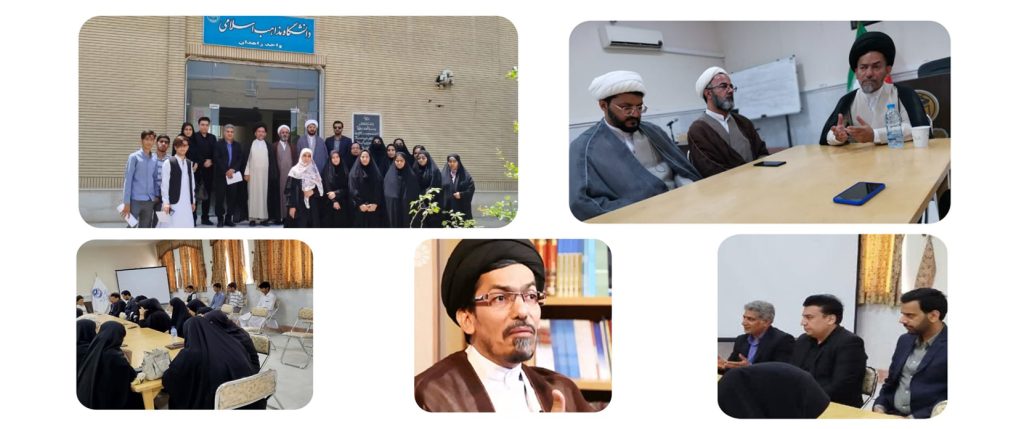
” TECODH, Zahedan, 3 May 2025: A workshop titled “the necessity of moving from slogan to action in achieving Islamic unity” was held at the conference hall of the Zahedan International University of Islamic Denominations. The event was organized in collaboration with TECODH, a private think tank.
The session was attended by Dr. Bameri, Head of the Supreme Leader’s Office at the Universities of Sistan & Balochestan province, alongside some faculty members and students.
Dr. Seyed Mehdi Alizadeh Mousavi, a faculty member at the University of Religions and Denominations, presented an analysis of the theoretical and practical dimensions of Islamic unity.
Highlighting the pressing challenges facing the Muslim world—such as conflict, division, and exploitation of sectarian differences—he emphasized the necessity of taqrib (approximation), describing it as a universal, humanistic concept vital for peaceful coexistence.
He urged students to go beyond credentialism, encouraging them to engage in critical thinking and theoretical innovation in the field of inter-sectarian dialogue.
Gathering information without analysis, Alizadeh Mousavi warned, leads to passivity.
This Islamic scholar cautioned against focusing solely on religious commonalities while ignoring differences, added that when we disregard differences, we allow our adversaries to manipulate them into sources of conflict.
The professor of political science called for the development of a mechanism to foster the conscious acceptance and management of religious diversity.
According to Alizadeh Mousavi, tolerance alone is not sufficient. We must pursue resectful, critical dialogue based on mutual understanding to prevent conflict and cultivate a genuine culture of dialogue.
In his concluding remarks, Dr. Alizadeh Mousavi described Iran’s religious and ethnic diversity as a valuable opportunity if properly channeled into scholarly discourse. It could become a strategic asset for the broader Islamic world.
The workshop concluded with a call for students to take an active role in transforming Islamic unity from a slogan into a sustained, actionable framework.