
TECODH. 26 January 2026
Hadi Lashkari, Graduate of Political Science, Islamic Azad University of Zahedan
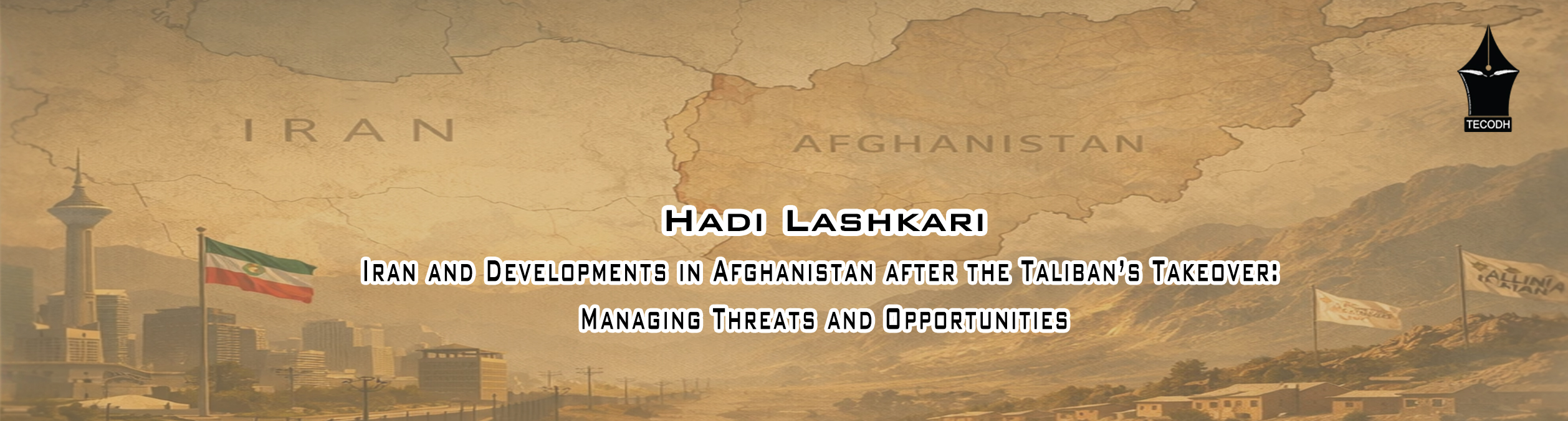
The collapse of the Afghan government and the Taliban’s sudden and renewed takeover of Kabul in 2021, became a pivotal factor in the foreign policy and national security doctrine of the Islamic Republic of Iran.
Iran’s initial response was combined with security concerns (ideological, social, border-related) and opportunism, aimed at filling the geopolitical vacuum created by the withdrawal of U.S. forces.
At present, Iran shares border with Taliban that is ideologically incompatible with the Islamic Republic and lacks international legitimacy. Consequently, stability or instability within Afghanistan directly affects Iran’s security, economic relations, and social cohesion along its eastern borders.
A noteworthy aspect of this period has been Iran’s ability to transform a potentially major security challenge—namely, Afghanistan’s possible emergence as a base for anti-Iranian operations or the presence of hostile powers after the U.S. withdrawal—into an opportunity to consolidate regional influence through diplomacy and the expansion of relations.
Iran’s foreign policy toward the Taliban has been shaped by several regional and national factors. First, the need to confront extremist groups such as ISIS-Khorasan, which pose a direct threat to Iran’s internal security. Second, efforts to maintain a balance in competition with actors like Saudi Arabia and Pakistan in order to prevent their dominance within Afghanistan’s future power structure. Third, preventing smuggling, border insecurity, etc.
On the other hand, the sudden U.S. withdrawal and the Taliban’s urgent need for international legitimacy and economic resources have strengthened opportunities for Iran in economic, commercial, and transit sectors. By leveraging geographic proximity, transport corridors, and consumer markets, Iran seeks to consolidate its economic position in Afghanistan.
Nevertheless, the success of this policy requires a careful balance between managing security threats and effectively exploiting geopolitical opportunities. Failure to properly address key issues could lead to serious tensions; a clear example is the Helmand River water rights dispute, which, as an environmental and political-security source of tension, requires a comprehensive and practical solution—one that has yet to be realized.
Therefore, the success of Iran’s strategy in engaging with the Taliban depends on multiple factors. The effectiveness of such policies hinges on Iran’s ability to balance between threat and opportunity. Moreover, Iran’s success is contingent upon the level of cooperation among other regional powers, the Taliban’s future approach toward neighboring countries, and internal developments within Afghanistan.
Join TECOD
www.tecodh.ir