
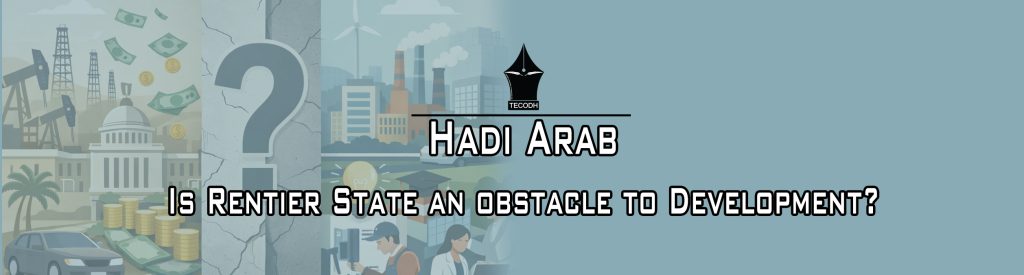
Hadi Arab
Researcher, TECODH
The concept of rent originated in economics and later entered political analysis, refers to revenues that a government or state primarily obtains through the sale of natural resources such as oil, gas, or other raw materials.
The theory of rentier state was first proposed by Hossein Mahdavi, an Iranian economist, in the early 1970s. Subsequently, other scholars expanded this theory and examined its economic and political dimensions.
Well, the key issue I would like to highlight here is that whether rentier state constitutes an obstacle to development? Since the 1960s, economists and political scientists have sought to explain why natural resources or natural wealth have often led not to sustainable development but to economic inefficiency and political authoritarianism. In a rentier state, government or institutions close to it tend to control key sectors of the economy. And, because the state is not financially dependent on society, its level of political accountability decreases. Under such conditions, the main focus of government is not to strengthen production, innovation, and entrepreneurship, but the focus is on extracting and distributing revenues from natural resources. Thus, since state income is largely independent of domestic economic performance, there is little incentive for economic reform or innovation. Historical experience—especially in natural resource-rich countries of the Middle East—shows that in such systems, society has limited political weight.
At the social level, rentier state can also produce significant negative effects. These include the spread of consumerism, weakening of work ethics, and decline of social capital. When access to financial resources depends more on proximity to the state and power networks than on creativity and innovation, development-oriented motivations within society are undermined. This often leads to frustration among entrepreneurs.
However, although the dominant pattern suggests that rentier economies often have harmful effects on development, this itself does not determine a country’s fate; rather, what matters is how it is managed. For example, the experience of Norway shows that if rent revenues are invested in education, infrastructure, the economy, and institutions, it is possible to move beyond rentier state. Norway is regarded as a successful example among natural resource-rich countries that has managed its resources effectively. Even some Gulf countries have attempted to follow parts of this path, although their results so far remain far from sustainable development.
Achieving an experience similar to Norway requires several key conditions. First, implementation of the rule of law. Second, the presence of effective oversight institutions. Third, transparent and efficient tax system. Fourth, natural resources should not become a permanent source for financing the government’s current expenditures.
In sum, a rentier state—defined as a situation in which rent replaces taxation and revenue distribution lacks transparency—usually represents serious obstacles to economic and political development. Yet, this outcome is not inevitable. Effective management of rent revenues and a shift toward a knowledge-based economy can pave the way for development. Therefore, the core issue is not the existence of natural resources, but how they are used in the process of governance and development.
06 February 2026.
Taheri Entrepreneurial Company for Daneshyaran of Humanities (TECODH) is a private, non-profit think tank (2003). www.tecodh.ir